
Ground Truth Before Assumption
Site conditions, inherited constraints, documentation quality and stakeholder inputs are examined before a decision baseline is accepted.
Outcome-oriented examples of owner-side advisory, design baseline control, vendor-neutral evaluation, and execution governance across complex technology and infrastructure environments.
Representative and anonymized engagement examples demonstrating how disciplined advisory support helps protect investment intent, strengthen project baselines, improve decision quality, and reduce execution risk.
Representative work shows how the same owner-side disciplines are applied across different project environments without repeating the proof narrative in separate sections.
Site conditions, inherited constraints, documentation quality and stakeholder inputs are examined before a decision baseline is accepted.
Scope, architecture, BOQ, proposals, exclusions and lifecycle implications are assessed against the owner’s intended outcome.
Milestones, issues, change, evidence, documentation and handover are made visible so that operational responsibility is transferred with greater confidence.
A complex industrial perimeter environment required modernization planning across surveillance, detection, visibility, operational control, and procurement decision confidence.
Complex perimeter environment with modernization needs, coverage gaps, operational visibility concerns, and requirement clarity challenges.
Coverage validation, blind spot reduction, design baseline review, compliance visibility, vendor-neutral evaluation, and procurement logic.
Stronger coverage visibility, reduced blind spots, clearer design justification, and more controlled procurement decision-making.
This illustrates how owner-side advisory can connect technical validation, design baseline control, procurement clarity, and execution-aware governance before major implementation commitments.
Relevant Advisory Area: Security & Surveillance Advisory
Large infrastructure-driven programs can lose control when requirement clarity, BOQ discipline, design logic, commercial assumptions, and delivery governance are not aligned.
Delivery environments exposed to inconsistent requirements, BOQ ambiguity, rework risk, commercial uncertainty, and baseline drift.
BOQ / SOW validation, design consistency review, commercial-risk visibility, governance checkpoints, and owner-side control framework logic.
Improved baseline consistency, stronger control over scope drift, clearer technical justification, and better visibility of execution dependencies.
Relevant Advisory Area: Infrastructure & CAPEX Advisory / Project Governance Advisory
Digital platforms require structured advisory when stakeholder experience, business enablement, scalability, security, and long-term maintainability must be aligned.
Enterprise digital environment requiring clearer platform structure, stakeholder journey logic, scalable information architecture, and future-ready governance.
Platform architecture review, stakeholder experience mapping, content-structure governance, development-readiness coordination, scalability review, and secure long-term direction.
Clearer stakeholder experience, stronger business enablement logic, improved platform governance, and a more scalable foundation for digital growth.
Relevant Advisory Area: Digital Platform Advisory
Enterprise technology and low-voltage environments require coordinated readiness when networks, systems, ELV interfaces, connectivity, cybersecurity, and operational support expectations must work together.
Mixed IT infrastructure, enterprise systems, connectivity, and ELV environments requiring clearer baseline definition, interface alignment, and operational readiness control.
Infrastructure suitability review, network readiness validation, ELV interface alignment, wireless connectivity assessment, support transition logic, and operational dependency mapping.
Improved readiness visibility, stronger technical coordination, clearer operational dependencies, and better owner-side control before implementation, transition, and handover.
Relevant Advisory Area: IT Infrastructure & ELV Advisory
Survey-led understanding is especially useful in modernization and recovery projects where existing conditions, gaps, and execution risks must be clearly understood before decisions are made.
A strong CCTV modernization or integrated security project begins with clear field understanding. Structured site survey, location-wise observation, existing-system review, and asset-condition documentation help reduce assumptions before design, BOQ validation, vendor evaluation, or execution planning begins.
This visual represents the type of survey-based documentation used to support project baseline development, risk visibility, and practical owner-side decision-making.
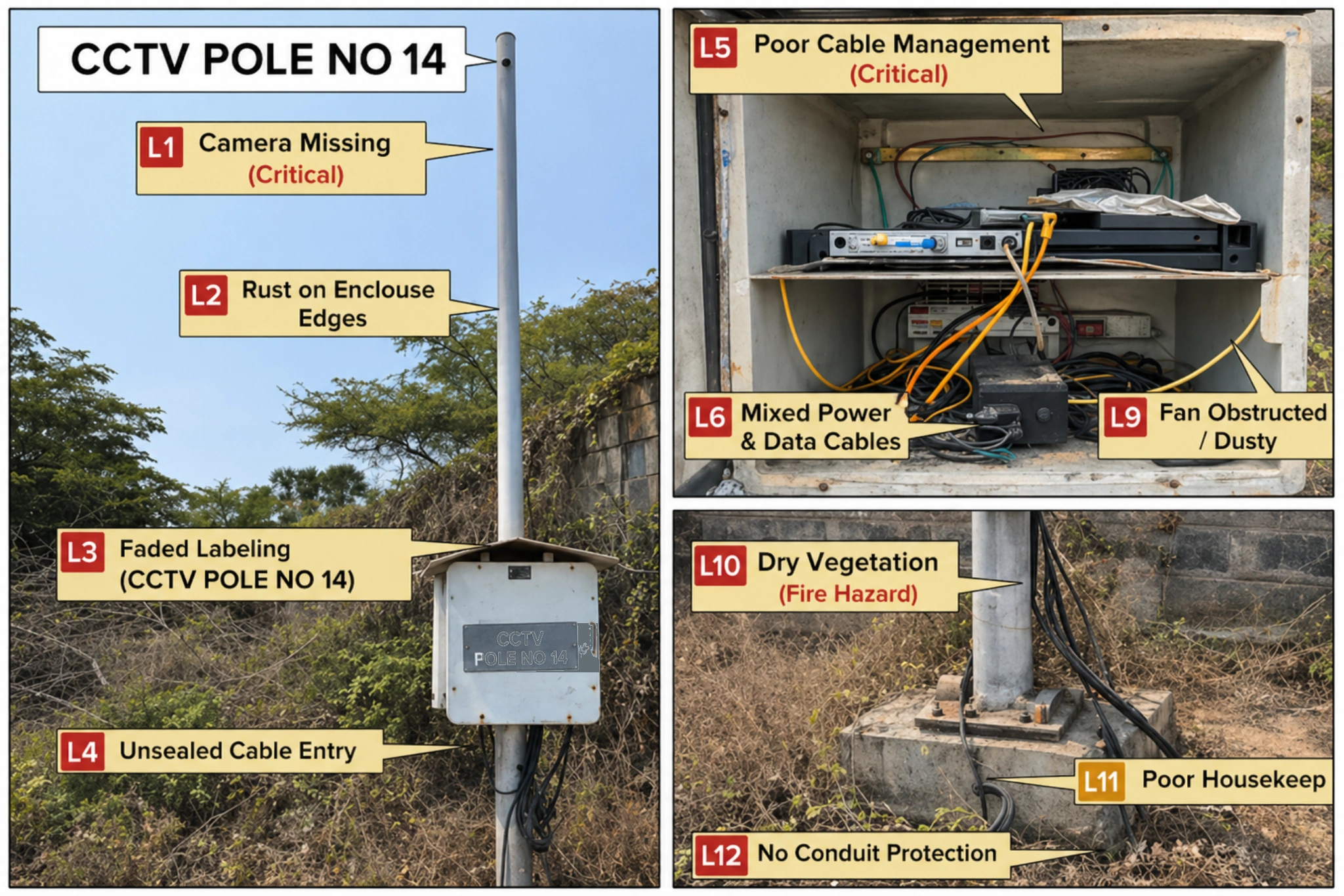
MTSS helps owners turn real site observations into clear review points before important design, BOQ, vendor, or execution decisions are made.
If your project involves modernization, design ambiguity, vendor influence, compliance exposure, or execution drift, an early strategic review can clarify the right path before risks become cost, rework, or delayed outcomes.